One Patient, Many Perspectives: IPE in Action Across Downstate
By Office of the President | Jun 2, 2026
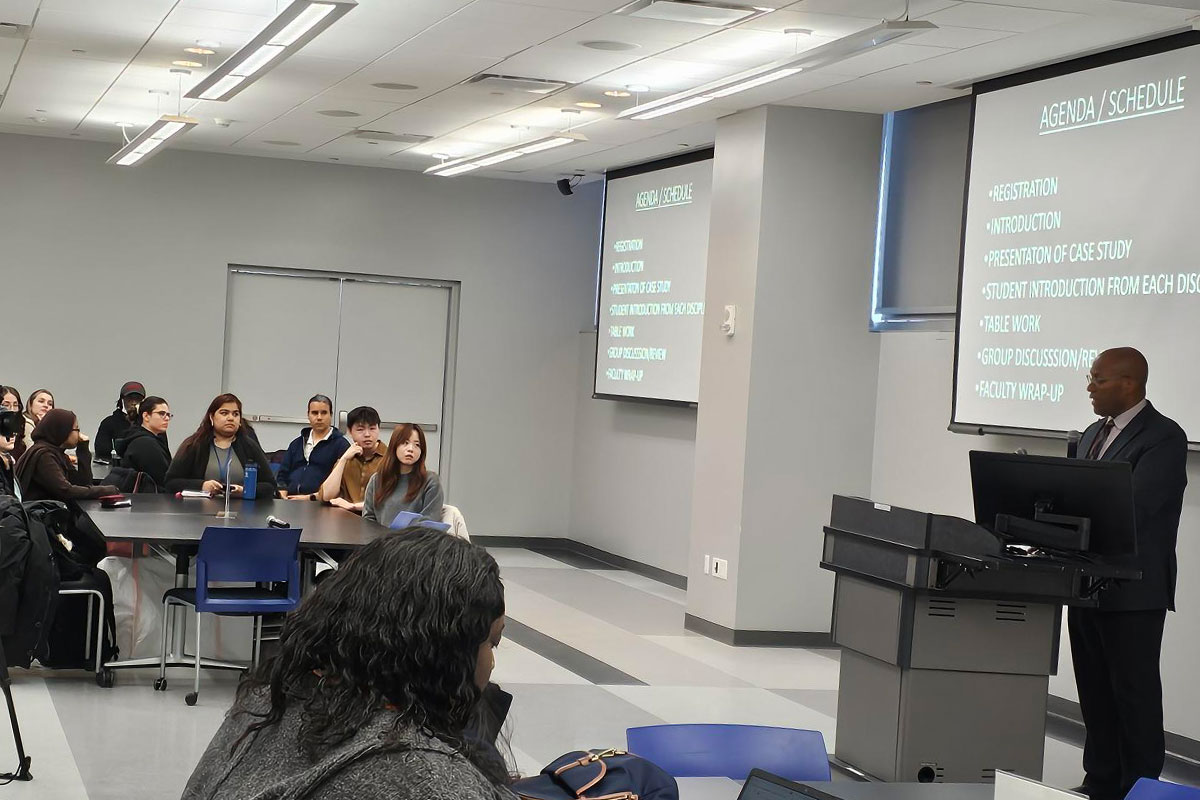
More than 200 students, faculty, and staff participated in the School of Health Professions’ (SoHP) annual Interprofessional Education Case Study (IPECS). Hosted in collaboration with the College of Nursing and the School of Public Health, the program engaged participants in a complex patient case designed to strengthen team-based care across disciplines.
Now in its ninth year, IPECS, developed by SoHP dean Allen N. Lewis, Ph.D., CRC, moves students beyond discipline-specific training into coordinated clinical decision-making. This year’s program also formed part of the 60th anniversary recognition for both SOHP and CON, reflecting a longstanding focus on collaborative practice.
The case centered on “Sharon,” a 32-year-old postpartum patient, educator, and recent immigrant adjusting to life in Brooklyn while caring for her young child. With a history of sickle cell disease and a prior pulmonary embolism, she sought care for persistent shortness of breath and fatigue as she prepared to return to work. Her symptoms were initially overlooked, delaying diagnosis. She was later diagnosed with chronic thromboembolic pulmonary hypertension, a serious condition that required coordinated care from multiple healthcare specialists.
SoHP students from Diagnostic Medical Sonography, Health Informatics, Midwifery, Occupational Therapy, Physician Assistant, and Physical Therapy looked at the case from distinct clinical perspectives, contributing to diagnosis and care planning. Nursing students emphasized continuity, care coordination, and patient management across settings, while School of Public Health (SPH) participants incorporated the community conditions that shape health and access to care, prevention strategies, and community-based factors influencing access and outcomes.
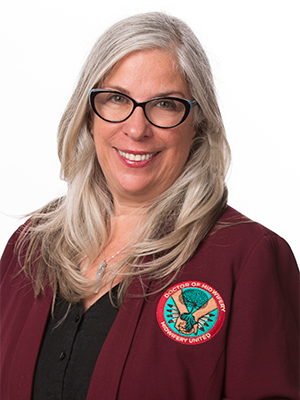
Susanrachel Condon, CM, LM, DM, FACNM
A live reenactment of the case, narrated by Susanrachel Condon, CM, LM, DM, FACNM, Interim Chair, Midwifery Program in the School of Public Health Professions, and performed by student actors, illustrated how clinical decisions unfold in practice. In-person and Zoom breakout sessions allowed participants to work through the case collaboratively, followed by a facilitated discussion on communication, roles, and shared decision-making.
IPECS is grounded in a straightforward premise: complex patients require coordinated care. The program reinforces the idea that outcomes depend on communication, shared accountability, and an understanding of each discipline’s role in patient care.
As the School of Health Professions and College of Nursing, and the School of Graduate Studies mark 60 years of educating healthcare and research professionals, IPECS serves as a reminder that collaboration remains one of the most important skills students can develop. By bringing future clinicians, public health professionals, and healthcare leaders together to solve complex problems, the program helps prepare graduates to deliver the coordinated, patient-centered care that today’s healthcare environment demands.
Tags: School of Graduate Studies, College of Nursing, School of Health Professions