Four Downtate Studies Offer New Insights into Vascular Care
By Office of Communications & Marketing | Jul 21, 2026
Over the past year, investigators in Downstate's Department of Surgery have published a series of studies examining limb preservation, pulmonary embolism, and healthcare delivery. Together, the studies address conditions commonly treated at University Hospital at Downstate and highlight opportunities to improve patient care. Here's a closer look at the research.
___
Patients treated at Downstate are often among those at greatest risk for complications from vascular disease, including chronic limb-threatening ischemia, the most advanced form of peripheral artery disease, and pulmonary embolism, a potentially life-threatening blood clot in the lungs.
Over the past year, faculty and trainees in Downstate's Department of Surgery published four studies exploring these conditions and the healthcare systems that influence their treatment.
The research was led by Panos Kougias, M.D., M.Sc., FACS, Professor and Chair of the Department of Surgery, and Sherene E. Sharath, Ph.D., M.P.H., Associate Professor of Surgery and Director of Clinical & Health Services Research, with contributions from surgery fellows and residents.
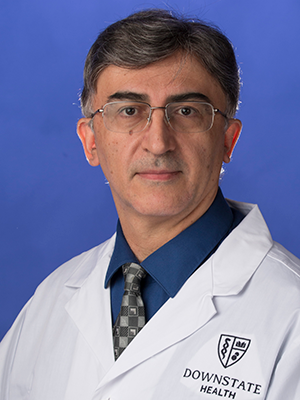
Panos Kougias, M.D., M.Sc., FACS
Professor and Chair of the Department of Surgery

Sherene E. Sharath, Ph.D., M.P.H.
Associate Professor of Surgery
Two of the studies examine chronic limb-threatening ischemia. Published in the Journal of Vascular Surgery, a study found that hospitals with fewer resources have higher amputation rates, reinforcing the importance of timely access to specialized vascular care, especially in safety-net hospitals. In a related invited editorial published in JAMA Surgery, "A Shared Call to Action for Amputation Prevention—Beyond Benchmarks," Drs. Kougias and Sharath discuss ways healthcare systems can reduce avoidable amputations through coordinated limb-preservation programs, stronger collaboration among specialties, and greater access to vascular expertise.
The other two studies focus on pulmonary embolism. Published in the Journal of Vascular Surgery: Venous and Lymphatic Disorders, the research, led by Department of Surgery trainees Claire Ferguson, M.D., and Pablo Cuartas, M.D., examines national trends in treatment costs, patient outcomes, and the increasing use of catheter-based therapies. The studies found that mortality continues to decline while newer treatment approaches are being used more frequently.

Claire Ferguson, M.D.

Pablo Cuartas, M.D.
The questions explored in these studies are closely connected to the care provided at Downstate. Physicians here routinely treat patients with peripheral artery disease, pulmonary embolism, and other complex vascular conditions, connecting this research to clinical practice.
These four publications add to a growing body of work from Downstate's Department of Surgery that examines how care is delivered, where improvements can be made, and how research can help improve patient outcomes.
See the publications below for more details.
- Hospital Resource Constraints and Major Lower Extremity Amputation in Chronic Limb-Threatening
Ischemia
Journal of Vascular Surgery
https://pubmed.ncbi.nlm.nih.gov/42413743/ - A Shared Call to Action for Amputation Prevention—Beyond Benchmarks (Invited Editorial)
JAMA Surgery
https://pubmed.ncbi.nlm.nih.gov/41879752/
- National Trends in the Cost of Pulmonary Embolism Care
Journal of Vascular Surgery: Venous and Lymphatic Disorders
https://pubmed.ncbi.nlm.nih.gov/42203147/
- Pulmonary Embolism Mortality Trends and the Impact of Advanced Interventions
Journal of Vascular Surgery: Venous and Lymphatic Disorders
https://pubmed.ncbi.nlm.nih.gov/42142851/