Downstate Study on Postoperative Transfusions Presented to NIH Pragmatic Trials Collaboratory
By Office of the President | Mar 17, 2026
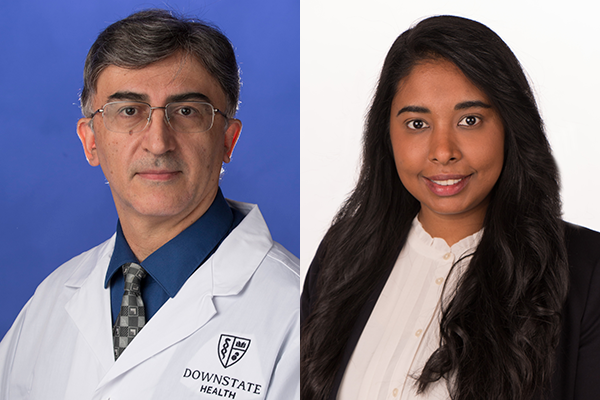
From Left to Right: Panos Kougias, M.D., MSc, FACS & Sherene Sharath, Ph.D., MPH
Each year, millions of patients undergoing major surgery receive blood transfusions, yet one fundamental question remains: when does a transfusion help—and when might it do more harm than good? That question is at the center of a clinical study led by Downstate researchers that recently drew national attention.
Last month, Panos Kougias, M.D., MSc, FACS, Professor and Chair of Surgery, and Sherene Sharath, Ph.D., MPH, Director of Clinical and Health Services Research, were invited to present their work during Grand Rounds hosted by the NIH Pragmatic Trials Collaboratory, a national program supported by the National Institutes of Health that convenes investigators from leading academic medical centers to advance the design, execution, and implementation of large pragmatic clinical trials embedded in real-world healthcare systems.
They presented findings from the TOP Trial (Transfusion Trigger after Operations in High Cardiac Risk Patients), a multicenter study examining transfusion strategies for high-cardiac-risk patients after they have undergone major surgery. This issue continues to inform discussions about transfusion practices and future research. Details of the study’s findings can be found here, and they remain part of ongoing discussions about transfusion practices in surgical care.
The Collaboratory’s Grand Rounds series features investigators whose studies address practical questions in patient care. Conducted across 16 Veterans Affairs medical centers, the study compared a restrictive strategy—transfusing when hemoglobin falls below 7 g/dL—with a more liberal strategy using a threshold of 10 g/dL. Hemoglobin, measured in grams per deciliter of blood (g/dL), is one way in which doctors determine whether a patient may need a transfusion.
Overall outcomes were similar for both approaches, though investigators noted that certain cardiac complications—including heart failure and arrhythmia—appeared more often when using the more restrictive transfusion threshold. The findings suggest that transfusion strategies may need to be tailored more closely to individual patient risk. This research helps clinicians determine when transfusions are most beneficial for patients with cardiac risk, supporting more individualized decisions during recovery after major surgery.
The NIH Pragmatic Trials Collaboratory, established by the National Institutes of Health, supports large clinical studies conducted within healthcare systems to answer practical questions that arise in everyday patient care. The program’s coordinating center, led by Duke University with partners including Vanderbilt University Medical Center, the University of North Carolina at Chapel Hill, the University of California, Los Angeles, and the HealthPartners Institute, provides the infrastructure for these studies across health systems nationwide.
The presentation highlights Downstate as one of the few pioneering multicenter trials tackling important healthcare problems head-on, delivering transformative insights for the vulnerable patients we serve daily as part of Brooklyn’s safety net.
Tags: Surgery