A Second Chance, Close to Home
By Office of the President | Apr 28, 2026
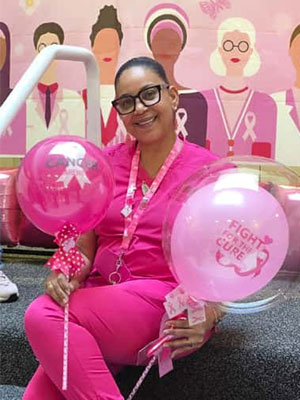 For nearly two decades, Denise John has lived with a second chance—one that marked the beginning of a new chapter after
years of uncertainty.
For nearly two decades, Denise John has lived with a second chance—one that marked the beginning of a new chapter after
years of uncertainty.
Before that moment, her life centered on end-stage renal disease (ESRD) and the demands of hemodialysis, even as she pursued her studies at Medgar Evers College. During her pregnancy, her dialysis schedule doubled from three sessions a week to six, while she continued to work full time. Despite the risks, she delivered a healthy child, an indication of her determination.
Dialysis continued as she waited for a transplant. When a compatible kidney from a deceased donor became available, Downstate surgeons performed the transplant that redefined her future, turning years of uncertainty into the possibility of stability and life beyond treatment.
Nearly 20 years later, and now a Staff Assistant in Transplant Services, Denise describes a life grounded in family and work, shaped by steady health and a lasting gratitude for the donor who made it possible. That same spirit carries into her creative work, from the thoughtful pink balloon creation she designed for Breast Cancer Awareness Month to her broader balloon artistry, memorial pieces, and celebratory designs, each one created to honor, uplift, and bring people together.
She recently shared her experience at a Brooklyn Kidney Club meeting with patients at similar stages of care. A strong advocate for Downstate’s Transplant Surgery program, Denise encourages patients to stay engaged in their treatment and to consider organ donation, underscoring the critical need for greater donor awareness in communities disproportionately affected by kidney disease.
The Brooklyn Kidney Club, coordinated by Betty Jung, RN, BSN, Patient and Community Health Educator in the Center for Community Health Promotion and Wellness, and Charmaine Browne, BSN, MSN, RN, Associate Director of Transplant Surgery, along with other members of Downstate’s transplant team, meets every other month. It brings together patients and families across all stages of kidney disease, offering information, peer support, and continuity beyond clinical care.
This approach reflects Downstate’s model of transplant care that integrates education and ongoing support into patient management. It also reinforces the importance of keeping care close for those most at risk, advancing Downstate’s #KeepCareClose commitment to addressing kidney disease and expanding access to life-saving treatment in our communities.
Denise’s experience highlights the long-term impact of transplantation and the role patients can play in guiding others through the process.