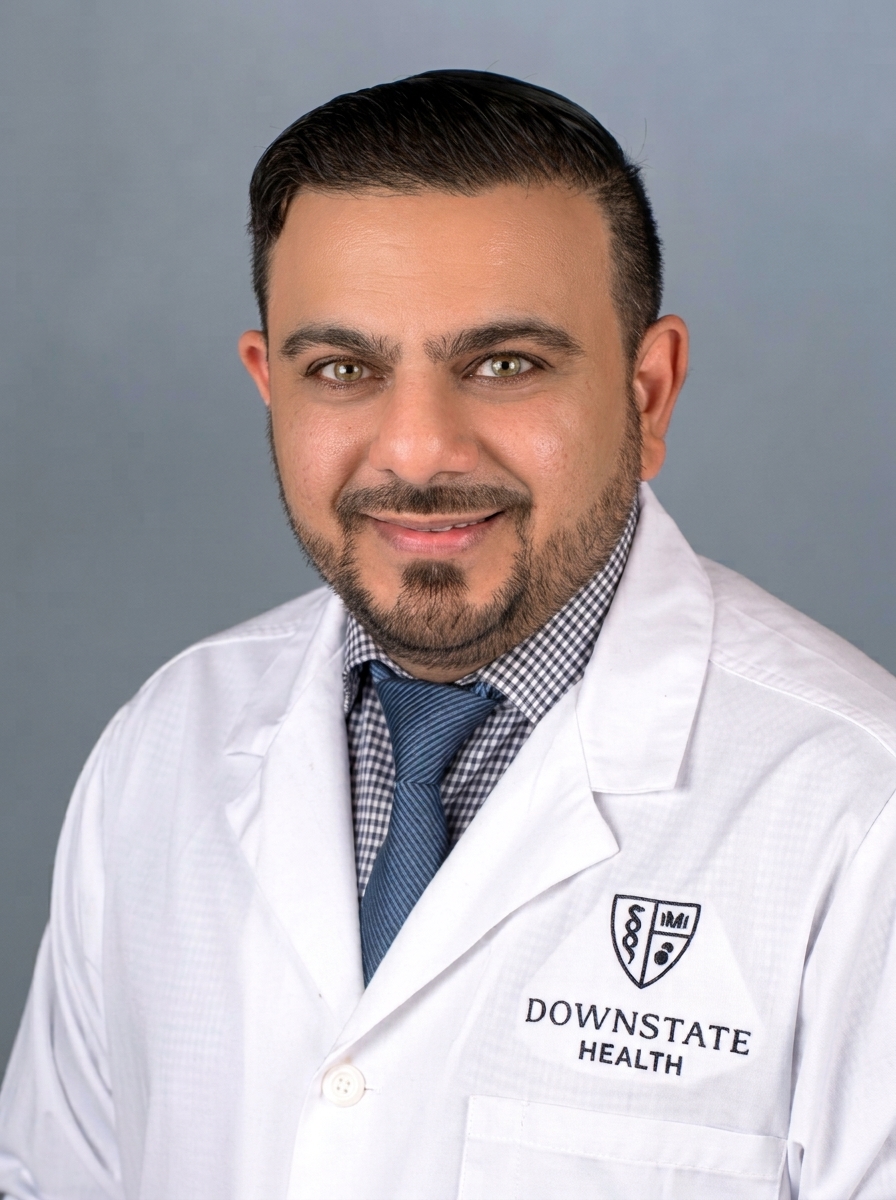
Fahad Ahmed, MD
Assistant Professor of Pathology
Department of Pathology
Attending Physician, Hematopathology and Surgical Pathology
Dr. Fahad S. Ahmed is a board-certified anatomic and clinical pathologist with fellowship training in hematopathology and advanced hematopathology. He serves as an Assistant Professor of Pathology at SUNY Downstate Health Sciences University. His clinical practice focuses on the autopsy services, general surgical pathology, and integrated diagnosis of hematologic diseases using morphology, immunohistochemistry, flow cytometry, cytogenetics/FISH, and DNA/RNA-based molecular testing. His academic work centers on hematologic malignancies, particularly hematological neoplasm biology and the tumor/immune microenvironment, together with digital pathology, computational/traditional biomarker development, and clinically translatable diagnostic and prognostic assays.
Education & Training
- Medical School: University of Karachi.
- Residency: Wayne State University; Chief Resident (as PGY-3)
- Fellowship: Fox Chase Cancer Center; Hematopathology
- Fellowship: Fox Chase Cancer Center; Advanced Hematopathology (Molecular and Translational Research)
- Research Training: Yale School of Medicine, Postdoctoral Research (Translational Pathology)
Certifications
- New York State Medical License
- American Board of Pathology, Anatomic Pathology/Clinical Pathology (AP/CP)
Dr. Ahmed's clinical interests center on diagnostic hematopathology and complex, integrated evaluation of hematolymphoid disease. His practice includes lymphoid neoplasms, acute leukemias, myeloid neoplasms, plasma cell neoplasms, myelodysplastic/myeloproliferative disorders, and reactive or non-neoplastic hematologic conditions involving peripheral blood, bone marrow, lymph nodes, spleen, and extra-nodal tissues. He is particularly interested in clinicopathologic integration of morphology and histology with immunophenotyping, flow cytometry, cytogenetics/FISH, and molecular diagnostics.
His research program focuses on translational hematopathology, with emphasis on lymphoma tumor microenvironment. His work applies spatial proteomic/transcriptomic profiling, quantitative immunophenotyping, digital pathology, machine learning, and multi-omics analysis to identify diagnostic, prognostic, and treatment-response biomarkers. A parallel interest is the development and validation of molecular and image-based assays that can be translated into clinically useful laboratory tests and precision-pathology workflows.
- Ahmed FS, Gaule P, McGuire J, et al. PD-L1 Protein Expression on Both Tumor Cells and Macrophages Are Associated with Response to Neoadjuvant Durvalumab with Chemotherapy in Triple-Negative Breast Cancer. Clinical Cancer Research. 2020;26(20):5456–5461. DOI
- Li P, Yuan J, Ahmed FS, et al. High Counts of CD68+ and CD163+ Macrophages in Mantle Cell Lymphoma Are Associated With Inferior Prognosis. Frontiers in Oncology. 2021;11:701492. DOI
- Acs B, Ahmed FS, Gupta S, et al. An Open Source Automated Tumor Infiltrating Lymphocyte Algorithm for Prognosis in Melanoma. Nature Communications. 2019;10:5440. DOI
- He M, Trontzas IP, Bates KM, et al. Quantification of Antibody-Drug Conjugate Targets in Head and Neck Squamous Cell Carcinoma. Molecular Cancer Therapeutics. 2026; online ahead of print. DOI
- Xirou V, Moutafi M, Bai Y, et al. An Algorithm for Standardization of Tumor Infiltrating Lymphocyte Evaluation in Head and Neck Cancers. Oral Oncology. 2024;152:106750. DOI
- Farahmand S, Fernandez AI, Ahmed FS, et al. Deep Learning Trained on Hematoxylin and Eosin Tumor Regions of Interest Predicts HER2 Status and Trastuzumab Treatment Response in HER2-Positive Breast Cancer. Modern Pathology. 2022;35(1):44–51. DOI
- Zhou J, Foroughi Pour A, Deirawan H, et al. Integrative Deep Learning Analysis Improves Colon Adenocarcinoma Patient Stratification at Risk for Mortality. 2023;94:104726. DOI
Selected Conference Abstracts / Proceedings
- Ahmed F, Frosch Z, Khanal R, et al. Machine learning based survival prediction of DLBCL: Using multimodal data. American Society of Hematology (ASH) Annual Meeting, 2025; Blood. 2025;146(Suppl 1):7068. Link
- Ahmed F, Yang Y, Frosch Z, et al. Uncovering Survival-Linked Genes in DLBCL: A Transcriptomic Analysis of 1,311 Patients. American Society of Hematology (ASH) Annual Meeting, 2025; Blood. 2025;146(Suppl 1):7064. Link
- Ahmed FS, Ji Y, Li P, et al. Assessment of Ki67 Proliferation Index in Mantle Cell Lymphoma with Digital Image Analysis. United States and Canadian Academy of Pathology (USCAP) Annual Meeting, 2020; Modern Pathology hematopathology abstracts supplement.
- Ahmed FS, McGuire J, Gaule P, et al. Quantitative Assessment of PD-L1 Protein Expression on Macrophages and Tumor Cells as Predictive Markers of Response to Neoadjuvant Durvalumab and Chemotherapy in Triple-Negative Breast Cancer. San Antonio Breast Cancer Symposium, 2019; Cancer Research. 2020;80(4 Suppl):P4-10-14.
- Li P, Ji Y, Ahmed FS, et al. High Counts of CD68+ and CD163+ Macrophages in Mantle Cell Lymphoma Are Associated With Inferior Prognosis. USCAP Annual Meeting, 2020; Modern Pathology hematopathology abstracts supplement. Link
Complete publication list: Google Scholar